

Production years: 1960–1977
Engine: 499.5 cm³
Power: 17.5 HP
Top speed: 95 km/h
Browse our classic Fiat 500 showroom →
The Fiat 500 Giardiniera is the car that proves you can fit a family and their luggage into something barely bigger than a telephone booth — as long as you’re clever about where you put the engine.
Launched in May 1960 alongside the 500 D, the Giardiniera (Italian for “gardener” — a nod to the estate car tradition) was Fiat’s answer to a simple problem: the standard 500 had almost no luggage space. The solution was brilliant in its simplicity: take the engine, lay it on its side, tuck it under the boot floor, and suddenly you’ve got a flat loading area where there used to be just a hot engine compartment.
The Giardiniera holds a special record: it’s the longest-running model in the entire 500 family. Production started in 1960 under the Fiat badge and continued until 1977 — two years after the last standard 500 rolled off the line. From 1968 onward, it wore an Autobianchi badge instead, but the car itself remained essentially unchanged.
Around 327,000 Giardiniere were built across 17 years of production.

The Engine — Laid on Its Side
This is the Giardiniera’s party trick. Fiat’s engineers took the standard 500’s 499.5 cm³ two-cylinder engine and turned it 90 degrees, laying it flat — or as they called it, “a sogliola” (sole-style, like the flat fish). This allowed the engine to sit beneath the boot floor rather than sticking up into the cargo area.
The result was a completely flat loading surface in the back — something no other car this small could offer. The engine itself was essentially identical to the unit in the 500 D: same displacement, same power (17.5 HP at 4,600 rpm), same Weber carburetor. But the cooling system had to be redesigned to work with the horizontal layout, and the exhaust routing was different.
The horizontally-mounted engine was designated as the Type 120 (the standard upright engine was Type 110). It’s a robust design that proved itself over 17 years of production, but it does require a mechanic who understands the specific layout — coolant circulation and oil distribution work differently when gravity isn’t pulling in the expected direction.
Longer, but Not Much Bigger
To make room for the rear cargo area and accommodate a proper rear seat, the Giardiniera’s wheelbase was stretched by 10 cm compared to the standard 500, bringing it to 1,940 mm. Overall length grew to 3,185 mm — about 22 cm longer than a regular 500.
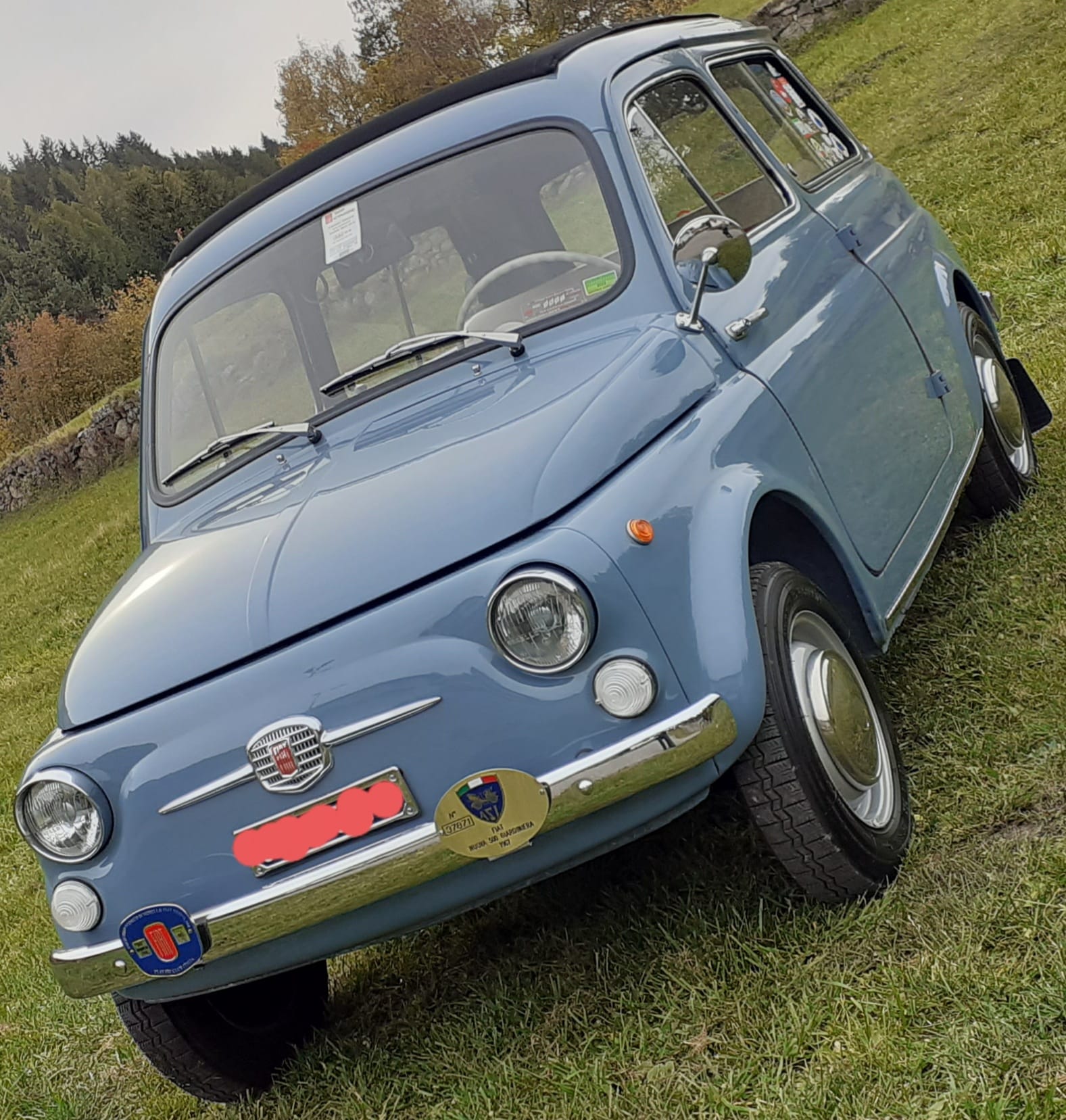
From the front, the Giardiniera looks identical to a 500 D. From the side, the difference is obvious: the roofline extends all the way to the rear instead of stopping short, and the body continues past the B-pillar to create the estate-style cargo area. The rear features a side-hinged tailgate instead of the standard 500’s engine cover.
Suicide Doors — All the Way to 1977
Here’s a detail that surprises many collectors: the Giardiniera kept its rear-hinged “suicide” doors for the entire production run. When the standard 500 switched to front-hinged doors with the 500 F in 1965, the Giardiniera carried on with the original door design.
This wasn’t laziness — it was practical. The Giardiniera’s longer body and different structural needs meant that switching to front-hinged doors would have required a significant (and expensive) re-engineering of the body structure. Since the car was selling steadily as it was, Fiat left it alone.
This makes late-production Giardiniere (1968–1977, wearing the Autobianchi badge) some of the last cars in Europe to feature rear-hinged doors on a production vehicle.
Other Distinctive Features
The Giardiniera had several features that set it apart from other 500 models:
- Front quarter lights (small triangular windows ahead of the main door glass) that could be opened for ventilation
- Winding windows — the standard 500’s fixed windows with sliding sections were replaced with proper wind-up windows
- Sliding rear windows on each side of the cargo area
- A metal roof rather than the fabric sunroof found on all other 500 models — necessary to support the longer, heavier estate body
- The Furgoncino panel van variant was also produced, with solid rear panels instead of glass — a tiny commercial vehicle
From Fiat to Autobianchi
In 1968, production of the Giardiniera was transferred from Fiat’s main plant to Autobianchi (a Fiat subsidiary based in Desio, near Milan). From that point on, the car was sold as the Autobianchi Giardiniera with Autobianchi badging, but mechanically and structurally it was the same car.
The change was partly a marketing move — Fiat wanted the 500 range to feel fresh with the new 500 L, and keeping the older-looking Giardiniera under a different brand helped avoid confusion. Autobianchi continued producing it until 1977, making the Giardiniera outlive every other 500 variant by two years.
Also known as the 500 K on some export markets, the Giardiniera was sold throughout Europe and beyond.
Buying a Giardiniera Today
The Giardiniera is one of the most sought-after classic 500 variants, and for good reason. It’s rarer than the standard models, it’s more practical, and it has a charm all its own. Prices reflect this — a good Giardiniera typically commands a premium over a comparable sedan 500.
Things to check:
- Engine orientation — the horizontal engine layout is specific to the Giardiniera. Make sure the cooling system is working properly — overheating is more common with the flat engine if the cooling ducting isn’t intact.
- Rear cargo floor — this is where the engine lives underneath. Check for rust, oil leaks seeping through, and that the floor panels are solid.
- Tailgate hinges — the side-hinged rear door sees a lot of use and the hinges can wear. Check for sagging and proper closure.
- Suicide door mechanisms — same as the 500 D, these need specific parts. Check that they work smoothly and latch securely.
- Badging — Fiat-badged Giardiniere (1960–1968) are generally more valuable than Autobianchi-badged ones (1968–1977), though both are desirable.
- Roof condition — unlike other 500 models, the Giardiniera has a fixed metal roof. Check for rust along the seams and around the window openings.
Looking for a Giardiniera? Let us find one for you →
TECHNICAL DATA:
ENGINE
- Type: 2-cylinder in-line, 4-stroke, air-cooled, horizontally mounted;
- Bore and stroke: 67.4 × 70 mm;
- Displacement: 499.5 cm³;
- Compression ratio: 7.0:1;
- Max power: 17.5 HP (12.9 kW) at 4,600 rpm;
- Max torque: 30 Nm (3.06 kgm) at 3,000 rpm;
- Fuel system: Weber 26 IMB carburetor;
- Ignition: coil and distributor;
- Lubrication: pressure with gear pump.
TRANSMISSION
- Gearbox: 4-speed manual, synchromesh on 2nd, 3rd, and 4th;
- Drive: rear-wheel drive.
BODY
- Type: steel monocoque, 2-door estate (3-door with tailgate);
- Seats: 4;
- Doors: rear-hinged (“suicide doors”) throughout entire production;
- Rear access: side-hinged tailgate;
- Roof: fixed metal (no fabric sunroof).
STEERING
- Type: worm and sector.
BRAKES
- Front: drums, Ø 185 mm;
- Rear: drums, Ø 185 mm.
SUSPENSIONS
- Front: independent, transverse leaf spring, hydraulic dampers;
- Rear: independent, coil springs, hydraulic dampers.
WHEELS AND TIRES
- Wheels: pressed steel, 3.5 × 12″;
- Tires: 125 × 12 cross-ply.
DIMENSIONS AND WEIGHTS
- Length: 3,185 mm;
- Width: 1,320 mm;
- Height: 1,325 mm;
- Wheelbase: 1,940 mm;
- Kerb weight: 560–570 kg;
- Fuel tank: 21 liters.
PERFORMANCE
- Top speed: 95 km/h (59 mph).
CONSUMPTION
- Approx. 5.5 liters per 100 km (mixed driving).